
 ZH
ZH  EN
EN  JA
JA  DE
DE 
新闻
高效阳极板:买家应该检查哪些方面
Why a high efficiency anode plate matters more than it first appears

A high efficiency anode plate is one of those parts that sits quietly inside a process, then suddenly becomes the reason a line runs smoothly or starts acting up. In industrial equipment, the plate is often judged by what it does not do: it should not warp, foul, drift out of position, or create extra resistance in the assembly. That sounds simple, but sourcing teams and engineers know the real challenge is finding a plate that fits the mechanical layout, holds up in service, and can be repeated from batch to batch without surprises.
If you are evaluating this kind of part, you are probably trying to answer a practical question: does the design support stable operation, or is it just a piece that happens to fit today? That is where material behavior, cut quality, and repeatability start to matter as much as the nominal shape.
Quick takeaways for buyers
- Repeatable geometry is not a nice extra; it is what keeps stacked parts, separators, and fitted assemblies aligned.
- Clean cut edges reduce the chance of burr-related assembly problems.
- Uniform sheet material is often more useful than a flashy specification sheet with missing process details.
- When the exact base material is not confirmed, ask for it early. Guessing at the end of the project usually costs more.
What the visible part style tells you
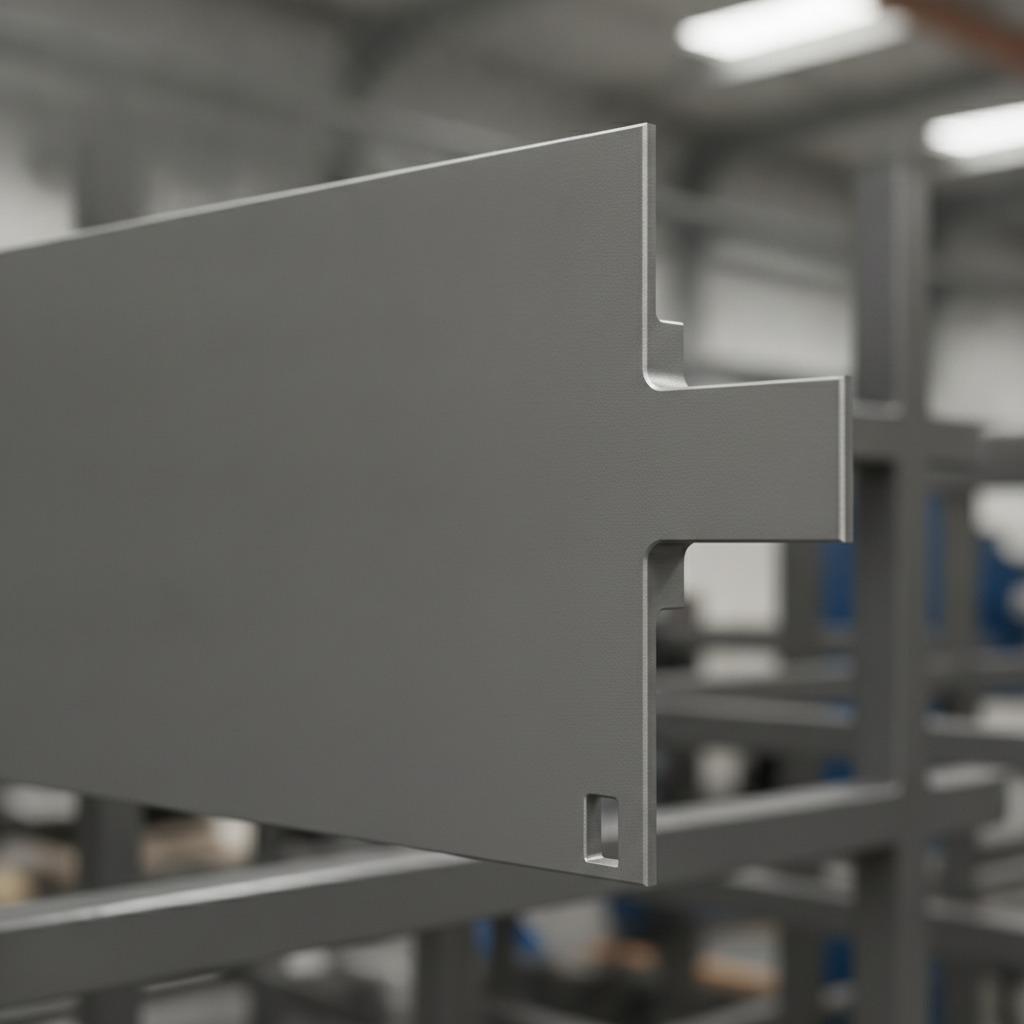
The product data points to a flat cut sheet component with a gray, matte, uniform finish and a fine textured surface. The geometry suggests a part made from sheet stock and cut by a process such as die cutting, waterjet cutting, laser cutting, or CNC routing. The image description also notes a rectangular body with a stepped or T-like extension, plus a small notch on one edge. Those details matter because they hint at how the part is intended to work in an assembly.
A shape like this is usually not decorative. It is doing one of three jobs: locating, spacing, or retaining. In some builds, the geometry helps a part seat one way and only one way. In others, it creates a predictable gap or keeps adjacent components from drifting under vibration. For an anode plate application, that kind of consistency can be the difference between a line that keeps running and one that needs regular adjustment.
Key selection criteria engineers should check
1. Geometry repeatability
Six similar parts shown in the image suggest a repeatable manufacturing approach. That is encouraging, but buyers should still verify dimension consistency on incoming samples. Even a small mismatch in tab height or notch location can ripple through a stacked assembly.
2. 边缘质量
Clean edges are not only about appearance. Rough edges can interfere with fit, create stress points, or complicate installation. If the plate must slide into a fixture, edge quality becomes a functional requirement.
3. Material suitability
The exact material type is not supplied, so it should not be assumed. For an anode plate or closely related industrial plate use, material choice will depend on the environment, electrical or chemical demands, and the mechanical load. That is the part of the discussion where buyer and supplier should slow down and stop hand-waving.
4. Surface finish and texture
A matte, textured finish can be useful where grip, reduced glare, or a controlled contact surface matters. But finish should always be considered alongside the actual application. A good-looking surface is not automatically the right one.
Common mistakes in sourcing custom sheet-cut parts
One frequent mistake is treating the part as “just a flat blank.” In reality, a stepped edge, notch, or tab may be carrying the functional load of the whole component. Another common issue is assuming the same process will work for every material. A shape that cuts cleanly in one sheet product may behave differently in another.
A smaller but costly mistake: not asking how the parts are nested, labeled, or packed. When multiple identical pieces are being supplied, handling matters. Bent tabs or scuffed surfaces can turn into field complaints before the part ever reaches the machine.
实用买家建议
If you are sourcing a high efficiency anode plate or a similar flat cut industrial component, request enough information to separate marketing language from manufacturable detail. Ask for the confirmed material, cut process, thickness, and any critical fit dimensions. If the supplier cannot confirm those items yet, that is not automatically a problem, but it is a signal to slow the purchase down.
For prototype and production buyers alike, sample parts should be checked in the actual fixture, not just against a drawing on a screen. Real assemblies always reveal the awkward little issues that drawings conceal.
常问问题
Is the part in the image definitely an anode plate?
Not from the supplied data alone. The visible part is a flat cut sheet component, and it may serve as a spacer, insulator, blank, or custom insert. The anode plate keyword should be treated as the search target, not as confirmed identification.
What process is most likely used?
The part appears suitable for die cutting, waterjet cutting, laser cutting, or CNC routing. The exact method is not confirmed.
What should buyers verify first?
Start with material identity, thickness, edge quality, and whether the cut geometry matches the assembly function. Those basics usually decide success more than the headline description.
下一步
If you are evaluating a high efficiency anode plate or a similar custom sheet component, the safest move is to review the part against the real assembly and confirm the manufacturing details before release. A good supplier should be able to speak clearly about the cut geometry, the material basis, and the repeatability of the parts shown here. That is where a useful buying decision begins.