
 EN
 ZH
 JA
 DE

Blog
How to Buy Titanium Anode Plate Sets: Technical Sourcing & Quality Guide
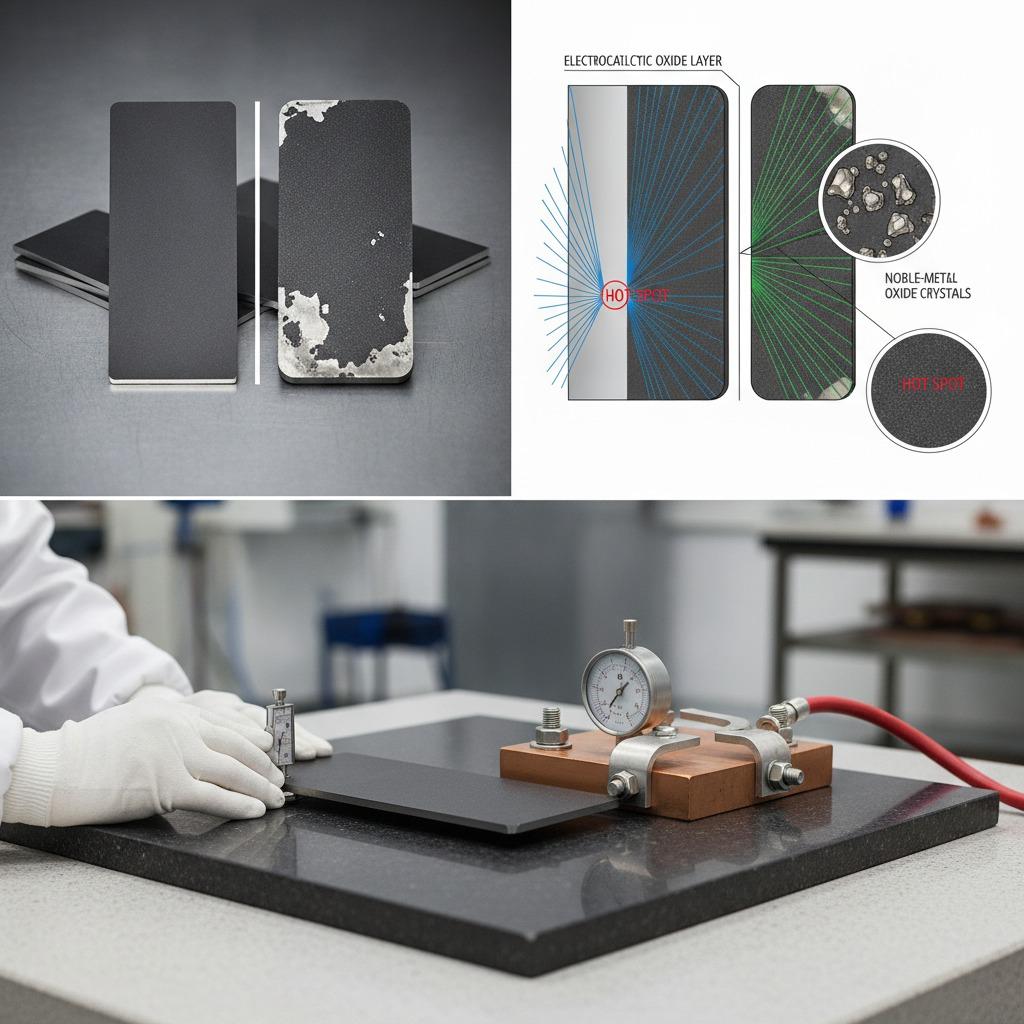
When maintenance teams or bench-scale plating operators need to buy titanium anode plate stock, they often encounter catalog listings with remarkably sparse documentation. A typical example is a multi-pack—often sold as a set of three flat, charcoal-gray rectangular plates categorized broadly under general electroplating hardware. The edges are neatly cut, the corners rounded, and the surface displays an even, matte black finish without obvious tooling marks. While such plates offer an accessible replacement option for small tanks and laboratory cells, procuring electrochemical hardware without fully validating the underlying metallurgical and chemical specifications can quickly lead to premature cell failure or tank contamination.

The Visual Pitfall: MMO Titanium Versus Graphite
One of the most frequent traps in general hardware procurement is assuming that a dark, non-reflective plate is inherently a mixed-metal-oxide (MMO) coated titanium substrate. In industrial electroplating and electrolytic recovery, two completely different materials share a nearly identical visual signature:
- MMO Coated Titanium: A dimensionally stable anode (DSA) consisting of a commercial titanium substrate (typically ASTM B265 Grade 1 or 2) coated with microscopic layers of electrocatalytic noble metal oxides—commonly ruthenium-iridium or iridium-tantalum systems—baked on via thermal decomposition.
- Fine-Grain Synthetic Graphite: An extruded or isostatically pressed carbon block machined down to plate dimensions, widely used for general electrolysis due to its low cost and reasonable conductivity.
The distinction between the two is critical. A graphite plate will slowly spall and shed micro-particles under higher current densities or in aggressive oxidizing baths, introducing particulate carbon that blinds filtration systems and fouls workpiece finishes. Conversely, an MMO titanium plate maintains its physical dimensions throughout its working life, releasing oxygen or chlorine without sloughing mass into the electrolyte. If a vendor does not explicitly state the base substrate and coating chemistry on their spec sheet, a sourcing manager must treat the material as unverified until confirmed by assay or certified test reports.
Four Factors to Specify Before Placing an Order
Before you buy titanium anode plate inventory for an existing electroplating line, jewelry bench, or effluent treatment cell, there are four operational parameters that require clarity.
1. Base Substrate and Noble-Metal Loading
If the plate is genuine titanium, the purity of the core metal governs corrosion resistance against aggressive acid attacks should the coating ever scratch or wear thin. More importantly, electrocatalytic activity relies on the coating loading, usually specified in grams of noble metal per square meter (g/m²). General hardware plates rarely publish these figures, which often signals a thin or decorative flash coating intended only for light duty or intermittent hobbyist use rather than continuous industrial shift work.
2. Electrolyte Chemistry Compatibility
Different MMO formulations are tailored to specific electrochemical reactions. Ruthenium-oxide-based coatings are optimized for chlorine evolution (such as brine electrolysis and sodium hypochlorite generation) but degrade rapidly in purely oxygen-evolving baths. For sulfate-based plating baths, acid copper, or electrowinning cells, an iridium-tantalum oxide formulation is necessary to resist oxygen evolution overpotential. Deploying the wrong formulation results in rapid passivation of the titanium substrate, causing cell resistance to spike within dozens of run hours.
3. Current Density Limits
Every insoluble anode carries an operational window for current density, measured in amperes per square meter (A/m²) or amperes per square foot (ASF). Operating outside this design threshold accelerates coating exhaustion. Flat plate anodes lacking published current limits force operators to guess their rectifier settings, risking hot spots and rapid coating peel.
4. Mechanical Mounting and Connection Methods
A notable feature of budget 3-piece plate sets is the clean, unfeatured geometry: no mounting holes, no machined slots, and no welded titanium feeder hooks. In an active tank, current must transfer into the plate without introducing copper or steel directly into the bath liquid. Sourcing completely plain rectangular plates requires the shop to have titanium clamping fixtures or titanium hanger bars on hand. Trying to drill through an MMO-coated plate post-purchase will chip the ceramic-like oxide layer around the hole perimeter, exposing raw titanium to localized pitting.
Evaluating Edge Quality and Geometry
Physical construction still provides valuable indicators of manufacturing care. Cleanly sheared edges with rounded corners—as seen on standard three-piece plate bundles—are a practical benefit. Sharp, ninety-degree corners on an anode concentrate electrical field lines, drawing disproportionately high current densities that can burn chemistry or strip the coating prematurely. Radius corners moderate this edge effect and minimize the risk of mechanical chipping during handling and rack assembly.
However, flatness is equally vital. If thin plates exhibit residual stamping bow or curvature, parallel tank placement becomes compromised. Uneven anode-to-cathode spacing produces varying resistance across the plate surface, yielding non-uniform plating thickness on the finished components.
A Practical Checklist for Sourcing Teams
If a supplier listing matches your dimensional requirements but lacks engineering data, request the following details prior to issuing a purchase order:
- Confirmation that the core material is Grade 1 or Grade 2 titanium, not conductive composite or graphite.
- The active coating chemistry (e.g., Ir-Ta for oxygen-evolving acid baths, Ru-Ir for chlor-alkali or chlorine-generating environments).
- Recommended pH range and maximum permissible bath temperature.
- Approved clamping methods or recommended titanium hardware for positive electrical connection.
For custom tank builds, pilot plants, or high-throughput electroplating facilities, avoiding unbranded consumables is standard practice. If you are preparing to buy titanium anode plate sets for production tanks, contact our engineering sales group with your tank dimensions, electrolyte profile, and target current density to receive certified plate specifications tailored to your chemistry.