
 DE
 EN
 ZH
 JA

Der Blog
Titanium Anode for Electroplating: A Technical Guide to Coatings, Hardware, and Selection
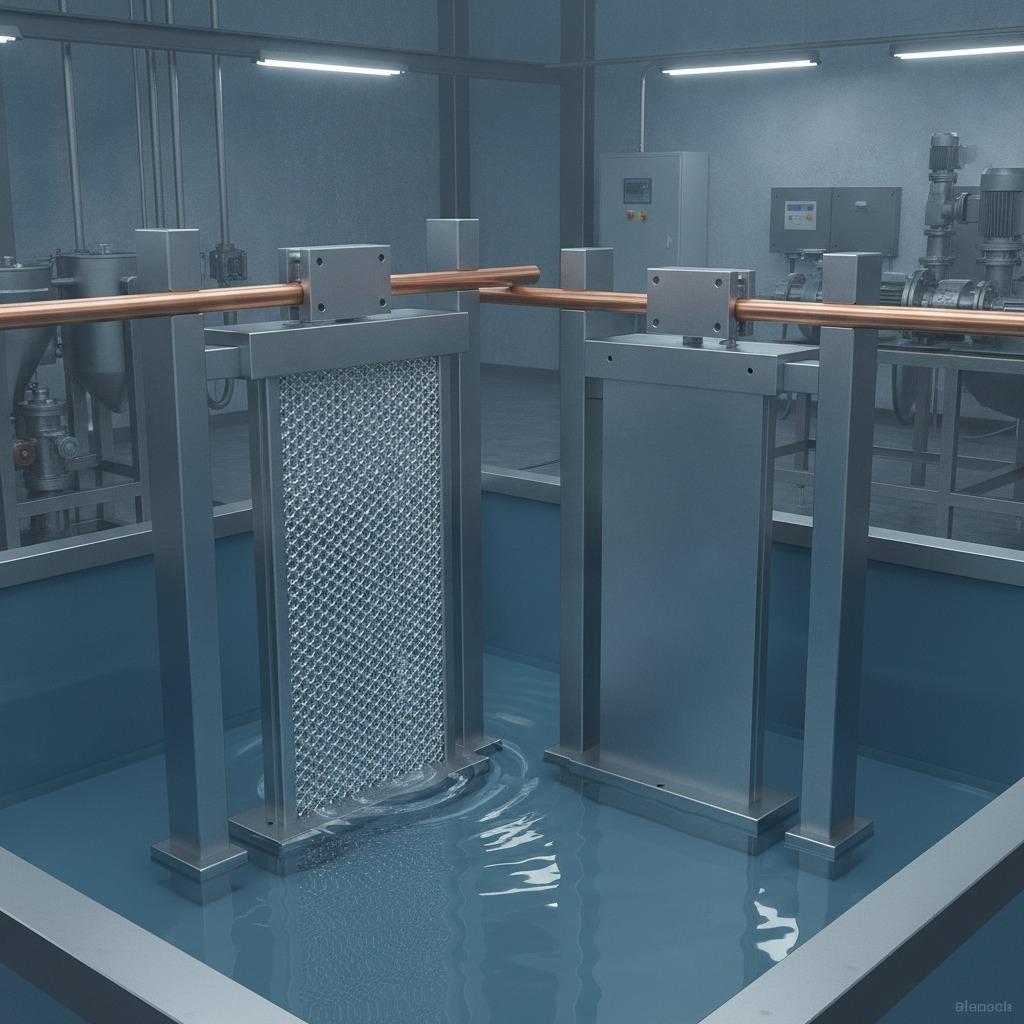
Specifying Insoluble Titanium Anodes for Industrial Electroplating
Process engineers running continuous reel-to-reel lines, PCB copper plating, or hard chrome baths eventually confront the limits of soluble metal or lead-alloy anodes. Dissolving anodes constantly alter inter-electrode distance, introduce sludge, and force maintenance crews to dump and filter chemistry far more frequently than production schedules allow. Integrating a titanium anode for electroplating—commonly known as a dimensionally stable anode (DSA)—solves these dimensional and contamination issues, but it also shifts your focus toward precise coating chemistry, current distribution, and the mechanical insulation that isolates the anode package inside the cell.
Choosing the right titanium anode is not simply a matter of swapping out a lead plate for a titanium mesh. Sourcing managers and cell designers must evaluate the substrate grade, the specific electrocatalytic formulation, operating current density, and the non-conductive hardware that holds the assembly in place. Overlooking how the anode is electrically isolated and sealed against tank walls or busbar brackets is often what triggers premature field failures.
Substrate Forms and Catalytic Coatings
Titanium serves as an inert, conductive backbone that forms a protective passive oxide film in acidic or alkaline baths. Because bare titanium will passivate and block current flow at relatively low voltages, it must be coated with an active noble-metal layer to sustain the plating reaction.
Substrate Geometries
Plating tanks generally deploy titanium in three configurations:
-
- Expanded Mesh: The most common choice for general surface finishing. Mesh allows electrolyte circulation, minimizes dead zones, and provides higher active surface area per pound of metal than solid plate.
-
- Solid Sheet and Plate: Selected where rigorous, directional current projection is required, or where the anode also acts as a hydraulic baffle or cell divider.
-
- Slotted or Perforated Tube: Often used in internal diameter plating or compact reel-to-reel cells where cylindrical symmetry is necessary.
Coating Chemistries
The coating must match the dominant anodic reaction in your bath. In sulfate-based or sulfuric acid baths (such as copper foil, zinc, or trivalent chromium), oxygen evolution dominates, requiring an iridium oxide-tantalum oxide (IrO2-Ta2O5) mixed metal oxide (MMO) system. In baths with significant chloride content or low-pH precious metal baths, platinum-clad or ruthenium-based coatings may be specified. Operating an oxygen-evolving MMO anode in a high-fluoride or high-chloride environment without an intermediate protective layer will rapidly strip the coating down to bare titanium.
The Overlooked Role of Dielectric Spacers and Gaskets
While the electrocatalytic mesh gets most of the engineering attention, the mechanical interface where the titanium anode for electroplating mounts to the cell body requires equal care. Titanium anodes are rigid and dimensionally stable, meaning they sit closer to the cathode to minimize cell voltage and reduce power consumption. That narrow clearance leaves zero margin for accidental contact or stray currents.
To maintain precise spacing and isolate electrified titanium plates from mounting brackets, cells routinely rely on flat, die-cut insulating pads, spacers, and custom gaskets. These components—typically cut from dense industrial elastomers, rubber sheets, or flexible non-metallic materials—feature custom stepped profiles, locating tabs, and cutouts designed to sit flush against the anode’s mounting tabs. A profile with a protruding tab and stepped edge allows assembly operators to key the insulator into a tank frame repeatedly, preventing alignment drift during bath agitation.
In wet-dry cell transitions, these flat die-cut parts double as liquid seals, preventing corrosive bath vapors from creeping along anode hooks into the copper busbar junction. Specifying these dielectric spacers with a clean profile-cut edge rather than a compressed hand-cut sheet ensures uniform clamping force across the titanium interface without crushing the insulator.
Core Engineering Selection Criteria
Before issuing an RFQ for titanium anodes or their associated assembly hardware, ensure your specification package covers these parameters:
| Parameter | Key Technical Requirement | Impact on Operation |
|---|---|---|
| Substrate Grade | ASTM B265 Grade 1 or Grade 2 Titanium | Low iron content ensures mechanical ductility and prevents galvanic micro-pitting under the coating. |
| Coating Type & Thickness | MMO (Ir/Ta) or Platinized layer (typically 2 to 20 g/m²) | Dictates anode operational lifespan under target current density (A/dm²). |
| Electrolyte Compatibility | Fluoride limits, pH range, and operating bath temperature | Aggressive bath additives (like HF) etch titanium substrates, causing premature coating flaking. |
| Hardware & Insulation | Die-cut elastomeric spacers, custom gaskets, and titanium fasteners | Maintains parallel anode-cathode spacing; prevents stray currents and short-circuiting. |
Common Operational Mistakes on Plating Lines
One frequent mistake is running insoluble titanium anodes under reverse current. If an operator uses the plating circuit for an electrolytic reverse-etch cycle, the noble metal oxide coating dissolves within minutes. Titanium anodes must never be made cathodic unless the supplier has specifically engineered a reversible barrier layer.
Another common issue stems from poor cell hygiene during rack loading. If a dropped part or an oscillating rack touches an active MMO mesh, a direct short occurs. The localized arc can blow a hole directly through the titanium plate. This is precisely why mechanical isolation spacers and edge bumpers made from cut non-conductive sheets are mandatory along the perimeter of the anode basket or frame.
Häufig gestellte Fragen
Can titanium anodes for electroplating be recoated?
Yes. Once an MMO or platinized coating reaches the end of its service life, the remaining active layer can be chemically stripped. As long as the base titanium substrate has not suffered severe etching or mechanical deformation, it can be sandblasted, etched, and recoated, saving 40% to 60% compared to buying a complete new assembly.
How do I know when the anode coating is depleting?
A steady rise in cell voltage at a fixed current output is the primary indicator. When the active catalyst wears thin, the anode polarization increases, forcing the rectifier to output higher voltage to maintain plating speed.
What materials should be used for anode mounting insulators?
Material choice depends entirely on your tank chemistry and bath temperature. EPDM, Viton, or chemically resistant closed-cell foams are commonly die-cut into flat locating pads and spacers for acid baths. You should avoid standard commercial neoprene in hot acid environments, as it hardens, cracks, and permits leakage.
Next Steps for Cell Design and Sourcing
If you are planning an anode retrofit or designing a dedicated electroplating cell, start by mapping your bath chemistry, temperature limits, and maximum current density. When ordering your titanium anode packages, provide both the anode drawings and the mating dielectric hardware profiles simultaneously to ensure the entire cell assembly fits securely on the line.